



RAICA is a project-based curriculum designed to help students and teachers learn about artificial intelligence by tinkering, exploring, and applying new knowledge to build projects they care about. Each module includes lessons to grow AI fluency, apply responsible design, and exercise computational thinking. RAICA applies Universal Design for Learning and the TPACK frameworks to create inclusive, empowering, and accessible materials.
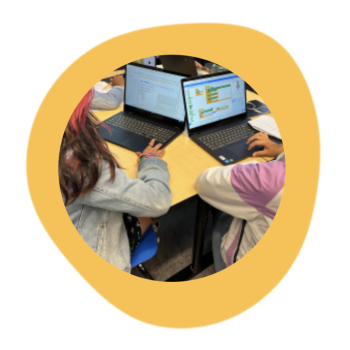
In Picture This, students explore how AI can tell apart images. Groups create projects using Teachable Machine—an AI image classifier tool—and the RAISE Playground, a block-based programming environment. They also apply responsible design practices, exploring data bias in neural networks.
|
|
| AI4K12: 1-A-ii,1-B-i, 1-C-i, 1-C-ii, 3-A-iii, 3-B-i, 3-C-i, 3-C-ii, 3-C-iii UK Computing: Key stage 3 and 4 CSTA: 2-AP-15, 2-AP-17, 2-IC-21, 2-CS-02, 2-CS-03, 3A-DA-12, 3A-IC-26, 3B-AP-08 UNESCO: 4.1.1.1, 4.1.1.2, 4.1.1.3, 4.1.2.2, 4.1.2.3, 4.1.3.1, 4.1.3.2, 4.1.3.4, 4.1.4.2, 4.2.1.2, 4.2.2.1, 4.2.4.2, 4.3.1.3, 4.3.3.2, 4.3.3.3, 4.3.4.3 |
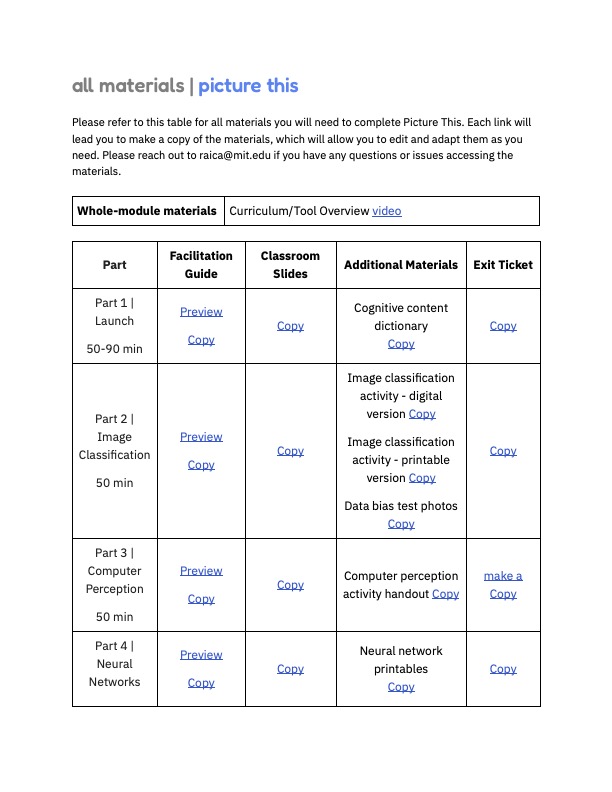
Click on the thumbnail to create a copy of the materials list for Picture This!
The RAICA curriculum is part of the MIT Responsible AI for Social Empowerment and Education (RAISE) Initiative, an MIT-wide initiative headquartered in the MIT Media Lab, in collaboration with the MIT Schwarzman College of Computing and MIT Open Learning. Check out the RAISE website (raise.mit.edu) to learn more and see the full offering of research and AI curricular materials for grades K-12.
Subscribe to the RAISE mailing list to stay up-to-date on future opportunities to co-design, beta test, and pilot with RAICA.